Local Library Open Doors, Some Want Them Closed
THIS STORY IS PART OF AN ONGOING SERIES ABOUT THE EFFECT OF METHADONE TREATMENT ON INDIVIDUALS AND THE NEIGHBORHOOD. PART I GAVE AN OVERVIEW OF METHADONE TREATMENT AND THE GOLDMAN CLINIC; PART III TOOK A CLOSE LOOK AT THE ISSUES SURROUNDING THE INTERSECTION OF FRONT STREET AND GIRARD AVENUE; PART IV OUTLINED THE POTENTIAL OF VIVITROL, AN ALTERNATIVE TREATMENT; PART V LOOKED AT HOW POLICE AND POLITICIANS HANDLE THESE PROBLEMS:
Broken Windows Part II
On a cold day outside the Ramonita de Rodriguez Library at 6th Street and Girard Avenue, a group of more than a dozen men and women wait for the black steel gates to open. When they finally do, most of them file in and take a seat in the open area between the stacks of books.
Members of the group quickly occupy the six available computers nearby. Five of those are logged onto Facebook. One or two folks grab a book or magazine, the rest converse quietly in the seating area.
The people are resident clients from the Goldman Clinic on a supervised visit.

“They come in a couple times a week,” said Lisa Chianese-Lopez, the Free Library of Philadelphia branch manager.
The visit is actually a formal part of the treatment services that Goldman provides. Laura Boston Jones, vice president of Behavioral Health Services at North Philadelphia Health System, said community services are important for recovery.
“[Methadone] is only one part of the service that we provide as it relates to helping people who have … substance abuse challenges,” Jones said. “[But] recovery can not simply take place here.”
Jones said the other part is getting clients involved with their community as a major part of their recovery. In an initial assessment of a client, Jones will ask several questions.
“Do you have a voter’s registration card? Do you have a library card? Do you have a driver’s license?” Jones said. “People who belong to a community have those things.

They vote. They use their local library. They drive and they can identify themselves and say, ‘This is where I belong.’”
The hour or so at the library is not necessarily free-time.
Enjoying the story? Don’t miss PART III
“Sometimes that may be research [time],” Jones said. “A [client] may have a particular…mental health challenge…or [physical] health challenge. We’ll tell them to research ‘diabetes.’” The client will then present their findings to their peers, according to Jones.
A local methadone client said treatment like this works. Tom G. said he is looking for work in the building trades and can do job research at the library.
“There are programs out there for people in recovery and ex-offenders,” Tom G. said.
“But how can you find out about them if you don’t have a computer?”
Tom G. describes many ex-offender employment programs as great opportunities albeit with some tough hurdles.
“One application was six pages long,” Tom G. said. “It takes a lot of time.”
Lopez does not dispute that the clients perform research. But she said there is more going on than education.
“They’re trying to reconnect with [people],” Lopez said. “I had one person here who saw her grandchild for the first time ever, on Facebook.”
They also take the library’s resources with them.
“They’ll check out books,” Lopez said. “But mostly they take movies out.”
The thought of the Goldman clients in the public library does not sit well with many locals however. Some parents pulled their kids out of the after-school program recently.
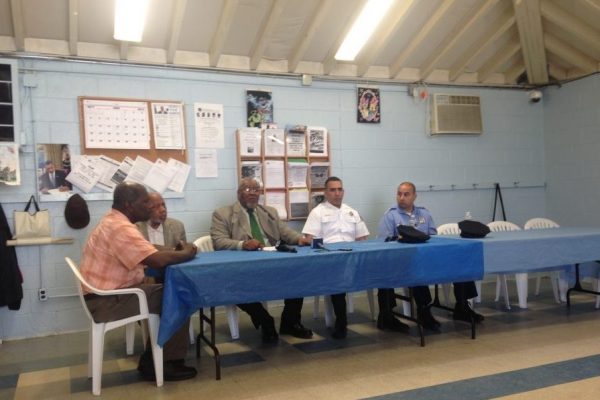
One resident, Cathy Califano, spoke up at the quarterly Northern Liberties Neighbors Association (NLNA) meeting on January 22, saying, “The environment at the library has [deteriorated] dramatically.”
Another community member said she often walks in the middle of Girard Avenue between 6th and 8th streets when she has her kids, to avoid fights and dealers.
Residents also wanted to know what happened to the police bike patrol, which was located there until recently.
Sergeant John Massi explained that the potential for Ferguson-inspired protests led the city to pull officers from every district to be on stand-by. That stand-by situation was set to end within days of that NLNA meeting.
Califano pointed out that people, “can’t get served at a bar if you’re intoxicated. Couldn’t there be a [similar] filter at the library?”
Massi said security at the library can handle those situations and they know they can also call 911.
Lopez did point out that things improved when the bike patrol was nearby.
“The officer they had here quickly [established] himself,” Lopez said. “It seemed like everyone was more responsive to him and respected him.”
Jones and Lopez are quick to distinguish between the organized groups from Goldman and the rogue visitors who may or may not be from Goldman.
“Whenever we come to the library as a group we come with a staff member,” Jones said. “We don’t send a group of clients to the library unescorted.”
Jones says it is difficult to keep tabs on all of their non-resident clients after they leave however.
Lopez says the individuals are allowed to come in to the library as long as they are behaved. There’s no reason to stop them. But she will not allow them into the children’s section, which is on the west side of the building.
“We keep a buffer zone for safety reasons no matter where [an unrelated adult] comes from,” Lopez said.
Lopez said the Goldman staff has responded to her calls when problems begin to arise and usually the people in question leave when Goldman staff arrive.
“We fall within their two-block zone that they cover,” Lopez said. Staff will respond to incidents within a two-block radius of Goldman if it may involve their clients.
Recovering addicts like Tom G. want people to know that the folks causing trouble are not representative of methadone users.
“[They] are just a … very small fraction of the people on methadone,” Tom G. said. “The rest of them are working or going to school or just trying to get their lives on track.”