My latest Netflix obsession is food writer Michael Pollan’s four part documentary series, “Cooked.” Based on his book by the same name, each episode focuses on different methods of cooking and each one is dedicated to a different element: fire, water, air, and earth. The series highlights methods of cooking, their traditions and evolution over centuries, and how they’ve influenced cooking as we now know it.
Pollan implements various cooking methods — like pit barbecue, braising, and fermenting — throughout each episode, stressing how simple the concepts can be implemented into daily life. But there was one scene that struck me in particular. After Pollan relays that the price of soda has decreased 7 percent in the past few decades while the price of fresh produce has increased 40 percent, he shares the summation of his food philosophy with the help of food economist Harry Balzer: eat as much of anything you want, so long as you cooked everything yourself.
That sounds like it would hinder plans for your beach body, but his point was that if folks were to truly live by that adage then they would not only cook at home more often, they’d make things as simply as possible with the best ingredients they could afford. Chances are that it’d also have a positive effect on one’s physical and mental health.
I couldn’t get this concept out of my head and it got to the point were grocery shopping became difficult and time-consuming. After my last trip, though, I came home without jars of processed spaghetti sauce and soup, but instead came home with the ingredients to make both items as simply as possible.
I was also fascinated by Pollan’s appreciation for the art of bread baking and his introduction of the sourdough starter seemed like a science project I could definitely handle. Simply mix ½ cup of flour with about ⅓ cup of purified water in a large bowl, cover it with a towel, and let it sit on your countertop for at least a week. Feed it — as if it were a new pet — ¼ cup of flour and ⅓ cup of water every 12 hours, mixing after each addition, twice a day until it’s ready to use. By the time mine was fully prepared to be incorporated into a recipe, it significantly increased in size and had plenty of visible bubbles — true symbols of a developed sourdough starter.
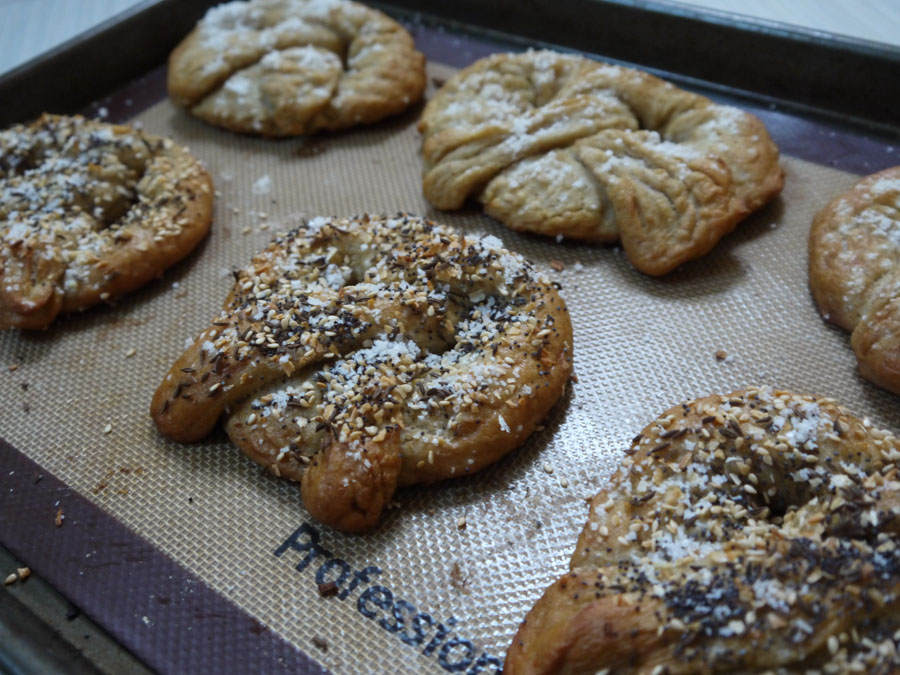
Granted, most sourdough bread recipes take hours for rising in between steps of kneading, something I was just too impatient to handle, but there are plenty of other recipes that are a perfect match for a sourdough starter: pancakes, biscuits, cookies, and soft pretzels. In no way am I suggesting you replace a corner-store soft pretzel fix by making your own all the time — there are some things you just have to leave to the experts — these were fun to make and didn’t last longer than a few hours in my house, just about how long they took to prepare.
Sourdough Soft Pretzels
Adapted from Renee Pottle
2 cups sourdough starter
1 tsp salt
1 ½ tablespoons sugar
2 ½ cups unbleached, all-purpose flour
½ cup whole wheat flour
¾ to 1 cup warm water
Combine all ingredients in a standing mixer with a dough hook and mix for 10 minutes. (Alternatively, combine ingredients and knead by hand until smooth and elastic, about 15 minutes.) Place in a lightly greased bowl, cover and let rise in a warm place until just about doubled, 2 to 4 hours. Gently fold to deflate the dough, cut into eight pieces, and roll each piece into desired shape, pressing dough pieces together where they touch. Set each pretzel on a parchment lined baking sheet, cover and let rise in a warm place for 1 to 2 hours, or until puffy.
Preheat oven to 425 degrees. Meanwhile, bring a large pan of water to a boil. Carefully add ¼ cup baking soda to the boiling water, as it will bubble up. Gently remove pretzels from baking pan and drop into the boiling water. Simmer, two at a time, for about 45 seconds. Remove with a slotted spoon and return to the baking sheet. Repeat with remaining pretzels. Sprinkle pretzels with kosher or flake salt, sesame or poppy seeds, or other desired topping. Bake for 20 to 30 minutes or until golden brown.