More Bad Gas in Port Richmond?
PGW is Looking into Expanding Natural Gas in the Riverwards
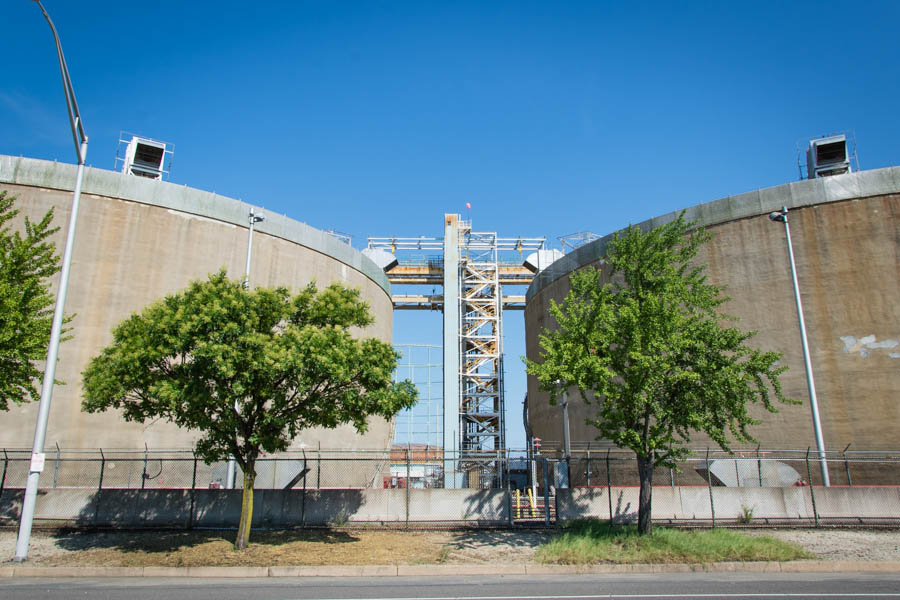
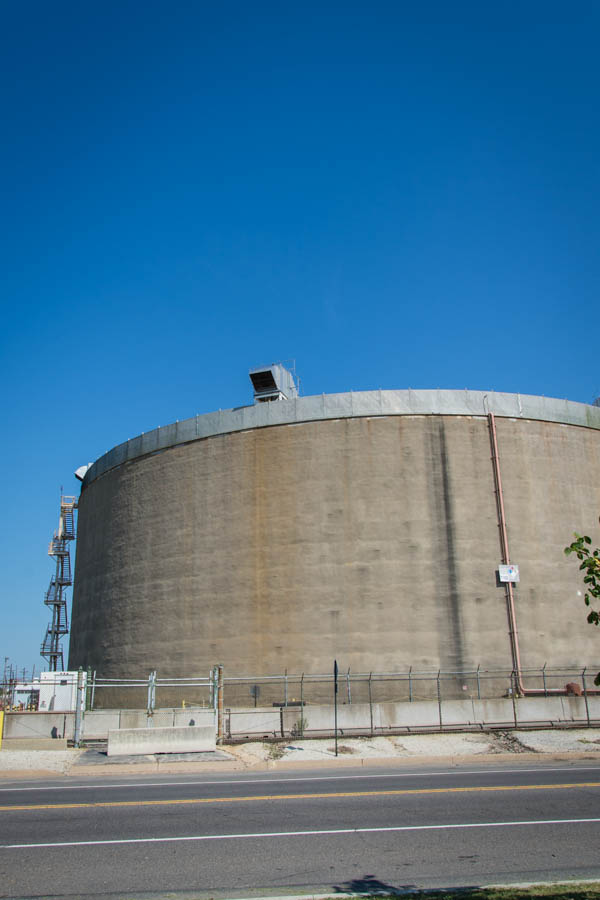
The two current LNG holding tanks at the Port Richmond facility
Philadelphia Gas Works is considering proposals to expand the natural gas liquefaction capabilities at their 3100 E Venango St. plant in Port Richmond to sell natural gas in higher volume than they do now. This is one among several parts of a larger plan to resurrect the city’s energy industry.
The Gas Works’ Port Richmond site is currently a “peak shaving” facility. Natural gas is piped in year-round and cooled to -260°F for storage. About half of the gas comes in from western Pennsylvania. The rest comes from other states like Texas and Louisiana.
At -260°F, the gas shrinks to about 1/600th its size and turns to liquid, or “liquefied natural gas” (LNG), as it’s known to many. That liquid is stored in two 12-story silos at the Port Richmond plant. Gas Works later reheats the liquid and pipes it out again during winter months when gas demand typically spikes.
Right now, there’s more than enough on-site storage capacity for the operation. But Gas Works wishes to liquefy more natural gas than the city needs and sell the surplus to generate extra revenue.
Since January 2014, Gas Works has sold about $8 million in surplus LNG, according to March testimony by Gas Works CEO Craig White in front of City Council. The proposed facility enhancement could boost LNG sales by tens of millions of dollars a year. So devoted, such revenue could help offset future gas rate increases. A May 2015 feasibility study by consulting firm CH-IV concluded the proposed enhancements would cost at least $52 million.
To the chagrin of some activists and residents, we know little else about the plan. Gas Works hadn’t returned requests for clarification when this article printed.
The idea to enhance the Port Richmond facility to do more LNG trade isn’t new. Gas Works and Mayor John Street floated a proposal in 2005 to expand the facility as an LNG import base. City Council vetoed the idea in 2006 with a resolution
not to enact any legislation needed to implement that project, and further expressing Council’s unqualified opposition to any project that would create an LNG shipping terminal within the City of Philadelphia or that would cause loaded LNG tankers to regularly traverse the Delaware River alongside the City of Philadelphia.
Draw your own conclusions about why Council has softened its “No way” to “Let’s talk.” Only two sponsors of the 2006 “No way” resolution, Darrell Clarke and Blondell Reynolds Brown, still sit on Council in 2015. Neither attended the Special Committee on Energy Opportunities for Philadelphia, which Council held this past March.
Six hours of footage from the hearing is available on Youtube. The first segment of the video had received 35 when this article printed. Spirit News staff will vouch for five of them.
City Hall intrigue aside, there’s a clear fiscal explanation as to why the plan to sell surplus LNG has been exhumed. Fracking has over the past decade reversed the supply-demand relationship between the US and the world concerning natural gas. As a country, we’ve got much more of it now than we did 10 years ago. There’s also loose industry consensus that natural gas demand by Europe and Asia will increase over the next few decades.
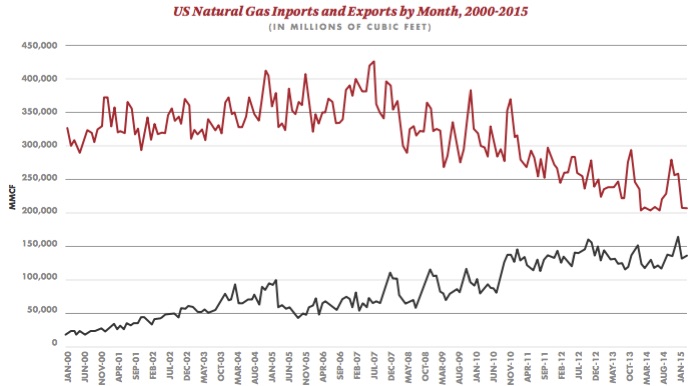
Source: US Energy Information Administration. Natural Gas.
Philadelphia Energy Solutions CEO Phil Rinaldi and others argue that we could only ship LNG from the Richmond plant up and down the east coast. Only the largest classes of seagoing LNG tankers can cross the Atlantic Ocean. The Delaware River isn’t deep enough and the bridges between New Jersey and Pennsylvania aren’t high enough for those large tankers to pass through, according to Rinaldi.
Would ships need to transfer LNG cargo first or could they go directly from Philadelphia to London? It’s unlikely that Gas Works’ accountants are worried about export details right now, given the potential profits such business would produce. Natural gas sale prices are set to increase from $10.60 per million BTUs now to $15.47 per million BTUs by 2040, according to government projections.
The economic push-and-pull has changed, but the security risks that irked everyone regarding LNG trade expansion ten years ago remain. Increased LNG export from Port Richmond could mean sending large tanker ships, hauling potentially combustible cargo, under the Ben Franklin Bridge and alongside Center City on a regular basis. It would also mean an increase in the number of LNG-bearing tanker trucks traveling through the city. These tankers can be quite dangerous.
While LNG can’t burn as a liquid, it begins to evaporate and expand back into flammable gas the moment that mechanisms designed to keep it cool stop working. This can cause pressure to quickly build inside the LNG containers.
In 2002, a truck with about 13,000 gallons of LNG onboard turned over and exploded en route to Catalonia, Spain. A bystander suffered second degree burns from 650 feet away. The explosion rained shards of aluminum in an 840 foot radius surrounding the incident site, according to one subsequent study.
On-site LNG storage tanks like those at the Richmond site can and sometimes do explode as well. A Cleveland LNG plant, among the first ever built, blew up in 1944. Wartime resource scarcity led engineers to skimp and build one tank at the Cleveland plant from steel with an unusually low proportion of nickel in it. This made the tank brittle at cold temperatures, according to a government report. The tank broke and leaked LNG into the surrounding sewer system, effectively turning it into a giant underground pipe bomb. The contingent explosions and fires killed 129 people.
The technology needed to liquefy and store natural gas is still relatively young. It’s also complex and involves a lot of steps. LNG mishaps for these reasons often occur under unique circumstances that can be hard to foresee. In 2004, a liquefaction unit at an Algeria-based LNG facility sprung a leak and sent flammable vapors through a combustion fan into a steam generator. The water boiler ignited the vapor, resulting in an explosion that killed 29.
The PR rejoinder here is easy: these are isolated incidents. Nothing bad happens most of the time. The LNG industry, according to the 2014 Handbook of Liquefied Natural Gas,
has a long and excellent safety record, due to strict industrial safety standards applied worldwide. Up to 2012 there have been some 50,000 LNG carrier voyages, without a significant accident or safety problem (i.e., loss of containment) either in port or on the high seas.
It’s an unlikely scenario, but suppose the Richmond plant did suffer a catastrophe. What is potentially at risk in the surrounding area? To begin with, the Gas Works’ LNG storage tanks sit less than a mile south of the base of the Betsy Ross Bridge. The nearest residential properties are under a half a mile away, but the largest potential threat is right next door. An explosion at the Richmond plant could affect the chemical stores at Kinder Morgan Terminals, which border the facility to the southwest.
Philadelphia Emergency Management Office records show that Morgan, a Houston-based energy firm, regularly moves decent amounts of benzene, phenol and toluene through their Port Richmond site: all stuff you’d be ill-advised to pour over Cheerios or send airborne at high temperatures into a populous residential area like Port Richmond.
While the likelihood of a catastrophic accident is low, it’s worth thinking about what could happen if something did go wrong. In this case, the Richmond Plant may pose a significant threat.
But, as Gas Works CEO Craig White assured Council during the March hearing, “LNG is an expertise of PGW—it is truly our ‘sweet spot.’” Other than two administrative violations last year and two on-site spills since 2000, he’s to an extent correct. Nothing’s blown up so far.
We’re still waiting on the Pennsylvania Department of Environmental Protection for more comprehensive records on the managerial track record at Gas Works’ Port Richmond plant. We’re also waiting for more information about the chemicals stored at the nearby Kinder Morgan Terminal. We’ll make these available online as we receive them.
Questions? Comments? Suggestions? Organizer Lena Smith of advocacy group Food & Water Watch, which opposes the Richmond plant’s expansion, will hold a discussion meeting on this issue September 14, 7PM, at Holy Name of Jesus Church, 701 Gaul St. Food & Water Watch will also solicit residents’ input regarding what they’d like to know about the Gas Works’ plan. The Spirit will follow up online with highlights from this meeting.