Subprime Loans Not Dead? A Look at Who’s Lending in the Riverwards
If the mortgage market is a dim cave of paperwork and intrigue, the Home Mortgage Disclosure Act (HMDA) is a torch. Given what a serious commitment mortgage loans represent for most people, it’s a bummer more don’t know this law exists.
Congress enacted HMDA in 1975 to fight racist and/or predatory mortgage lending and increase industry transparency. It requires that mortgage firms release lending data: the sum lent, loan type, the race and income of loan recipients and more. In this piece we will concentrate mostly on what information HMDA gives on mortgage loan interest rates.
HMDA data output is available online at http://www.consumerfinance.gov/hmda/explore. Policymakers, academics and anyone else can use the information lenders must provide under the Act to answer questions about the mortgage industry. Again, this information’s especially valuable given that it deals with what some consider a notoriously under-regulated industry.
The bad news for snoops is that HMDA’s limited in certain ways. For example, it treats interest rate disclosure mandates less as expectation and more as punishment. Regulation C of the Act requires that lenders must only report the
spread between the loan’s APR [Annual Percentage Rate] and a survey-based estimate of APRs currently offered on prime mortgage loans of a comparable type if the spread is equal to or greater than 1.5 percentage points for a first-lien loan (or 3.5 percentage points for a subordinate-lien loan).
Put plainly, the government watches the market to see what kind of interest rates most lenders put on mortgage loans and sets a norm based on it. It adjusts that norm monthly. Lenders must only report interest rates on loans they issued during a given month at significantly higher rates than that government-set market norm.
Curious about the local lending climate? We made a list of about 14,000 mortgage loans Riverwards residents received between 2012 and 2014 in order to see which lenders charged the highest interest rates during that period.
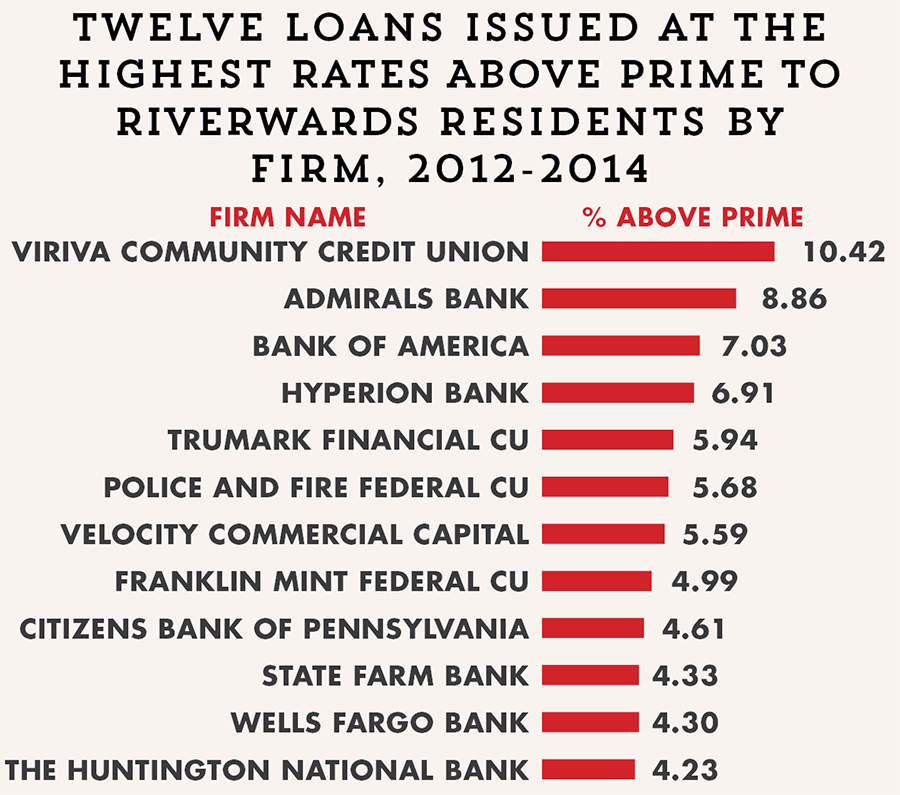
The first chart below shows a list of mortgages issued at the highest rates above the market norm and the name of the lender that issued each one:
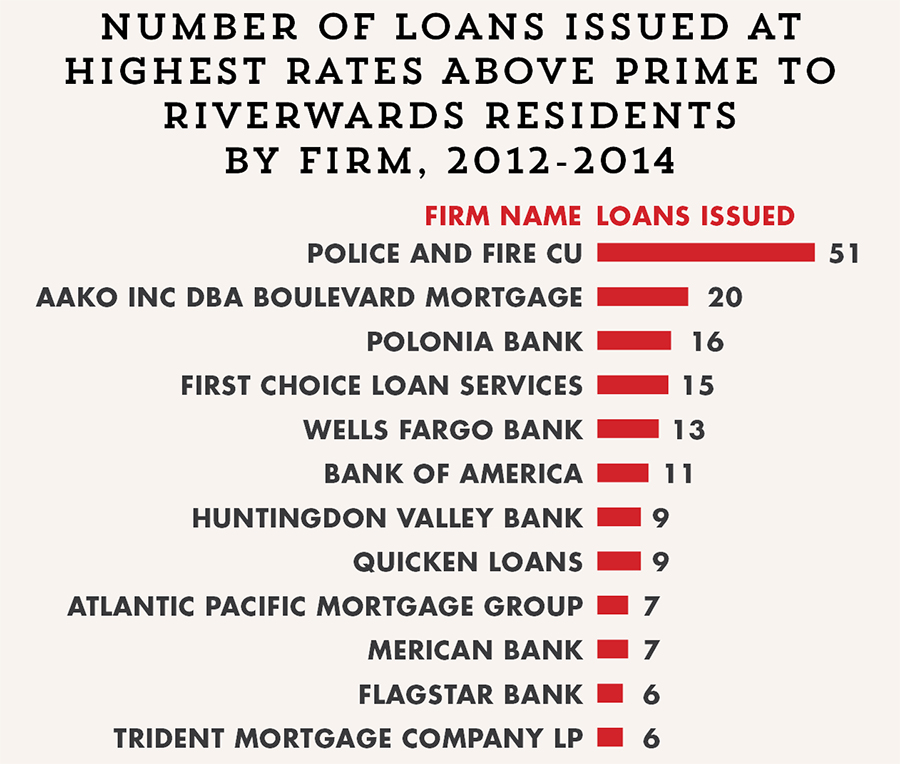
This second chart shows which lenders issued the most loans at significantly high interest rates since 2012:
Until new rules set to take effect in 2018 expand these disclosure obligations, industry defenders will maintain several important rebukes against claims about what HMDA data shows.
For example, HMDA disclosure information currently doesn’t account for many factors that cause mortgage lenders to drive interest rates up in the first place: applicants’ credit scores, employment history, etc. Furthermore, the interest rate information we do see only represents extreme cases of high-interest lending. This means HMDA information doesn’t accurately or completely represent firms’ lending policies or the industry more generally, according to the industry argument.
Why then should we gawk here and not somewhere else? Well, local law puts almost no cartilage between predatory lenders and consumers. That means we’ve got to make the most of available information to make informed borrowing decisions. Philadelphia City Council did enact notably tough lending regulations in 2001. The problem is that city government can’t enforce them.
Why not? Those city regulations set alarms off in finance industry political bunkers. Industry advocates immediately sued the City of Philadelphia, challenging Council’s authority to regulate financiers. Lobbyists laid into state government in Harrisburg at the same time. The Pennsylvania legislature soon thereafter stripped local governments’ right to regulate lenders: a gesture some interpret as a direct response to Philadelphia’s lending ordinance.
The result is that Philadelphia residents seeking legal recourse against those who have issued usurious mortgage contracts must look to state and/or federal law. Check out the Pennsylvania Human Relations Act § 5(h)(8) and the Pennsylvania Mortgage Bankers and Brokers and Consumer Equity Protection Act § 502(1). Federal regulations such as the Truth in Lending Act § 1639 and § 1671(a)(1) may also prove helpful, as will Dodd-Frank Act Title XIV. You may have ammo for a lawsuit if your mortgage contract includes anything these laws prohibit.
Consumer advocate and attorney Kimm Tynan of Philadelphia Legal Assistance told The Spirit in an e-mail correspondence that the worst predatory lending cases have since the turn of the century,
worked their way through the system. That’s not to say there aren’t still some rattling around out there, or that people aren’t still experiencing the repercussions [of predatory lending], just that we don’t see as many cases these days where predatory lending-related claims and defenses are raised.
But issues don’t just disappear when courts stop hearing about them and media interest wanes. 11.5 percent of first-lien mortgage loans issued last year qualified as “higher-priced” by the Federal Reserve’s national tabulation: the highest that proportion has been since the financial crisis.
Mortgage financiers and credit rating agencies didn’t speak up 10 years ago when they first had reason to suspect an impending economic crisis. Why should we think they’d do so now? Seems like ratting duties fall mostly to consumers. That’s why stuff like the HMDA is important.
Update: The Spirit published a letter to the editor by Viriva Community Bank President/CEO James F. McCaw in response to this article in the Nov. 11, 2015, available here.